What Makes Humans and Teams Thrive in an AI-Integrated Workplace?
As AI increasingly becomes part of teamwork, we need to rethink what makes individuals and teams effective.
Project Hephaistos explores the interplay between individual capabilities, team dynamics and human–AI collaboration.
More specifically, we ask:
Which skills, traits, and capabilities enable individuals to perform effectively as members of AI-integrated teams?
Which team configurations, processes and dynamics enable individuals and AI to work together as a high-performing team?
Why Hephaistos
The study builds on the influential project done by Google a decade ago. Google’s Project Aristotle showed that team effectiveness depends not simply on who is on the team, but importantly on how the team works together—highlighting psychological safety, dependability, structure and clarity, meaning, and impact.
As AI reshapes work, research increasingly points to changing demands on the individual. Studies highlight the growing importance of individual skills for the future of jobs, such as analytical thinking, flexibility, creative thinking, systems thinking and curiosity in addition to social skills, such as communication, empathy, and leadership (e.g., World Economic Forum).
Hence, it is time to revisit what makes teams effective. Hephaistos brings these two perspectives together, evaluating the potentially growing relevance of individual skills and team dynamics to drive performance in teams.
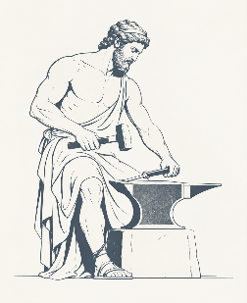
Hephaistos
The Greek god of craftsmanship, technology, and invention, who was said to have created artificial helpers to assist him in his work.
The name reflects our interest in how humans and AI can work together.
Our Research Approach and Findings
The project is developed in collaboration between SDU Business School and TalentFormation, a company specializing in AI-first transformation and the formation of high-performing product and technology teams. The collaboration brings together academic research with insights from AI-native work in practice and combines two study elements:
1. Qualitative Pre-Study
We began by exploring what changes when AI is already deeply integrated into everyday work. Through interviews with seven practitioners working AI-natively in software, data, and AI consulting, complemented by an academic expert, we examined which human skills, traits, and capabilities become particularly important—and what changes in the way teams work together. We identified recurring themes across the interviews and mapped these findings against insights from the existing literature.
In a nutshell, we find that as AI takes over more execution, the differentiating human contribution shifts toward deciding what is worth doing, taking ownership, and seeing the bigger picture. Adaptability and learning orientation, interpersonal and communication skills, as well as motivation and resilience remain essential, too.
MOVING TO THE FRONT
01 — Agency & ownership
Taking initiative, making decisions under uncertainty, and owning outcomes.
02 — Product & value creation
Focusing on what is worth doing and the value being created—not simply executing tasks.
03 — Critical judgment & systems thinking
Seeing the bigger picture, questioning AI output, and judging whether it is good enough.
04 — AI literacy
Knowing how to work effectively with AI.
REMAINING ESSENTIAL
05 — Adaptability & learning
Continuously learning and adapting.
06 — Interpersonal skills & communication
Communicating clearly, showing social sensitivity, and working effectively with others; empathy also with AI.
07 — Motivation & resilience
Maintaining drive and turning increased capacity into meaningful outcomes.
An overview of the findings of the qualitative study is provided in our qualitative research report, which you can download here:
2. Quantitative Study
Building on the qualitative pre-study, we are currently testing these ideas in AI-integrated teams. The study follows participants across two measurement points (before and after the project), allowing us to understand how much individual skills and traits contribute to performance in comparison to team structures and processes.
Pre-Measurement, T1
What people bring
- Professional experience
- AI literacy
- Openness
- Tolerance for ambiguity and risk-taking
- Emotional stability
- Adaptability
- Critical reflection
- Proactivity
→
Post-Measurement, T2
How the team worked
- Psychological safety
- Team trust & dependability
- Coordination, clarity and structure
- Shared understanding
- Communication and interaction
- Empathy
→
Post-Measurement, T2
What the team achieved
- Team performance
- Individual performance
- Peer-rated contributions
The first measurement captures participants’ professional experience, as well as the the individual capabilities that gained importance in AI work settings. The second measurement examines what happens as these individuals work together, including psychological safety, trust and dependability, as well as new forms of human–AI collaboration, and connects these to individual and team performance.
Data collection is currently underway.
We will publish findings here as the study progresses.
Participate in Hephaistos
Is your organization already working with AI-integrated teams?
We are interested in collaborating with organizations that want to better understand what makes individuals and teams effective when AI becomes part of how work gets done. If you would like to participate in the Hephaistos research, please get in touch.